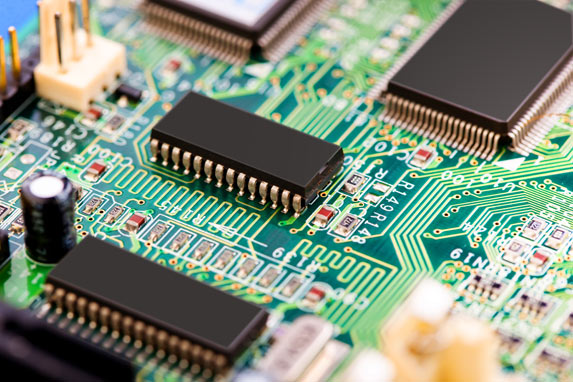
A Semiconductor Integrated Circuit (SIC) is a product that consists of transistors and other electronic components (such as diodes, resistors, and capacitors) that are inseparably embedded on or within a semiconductor material (like silicon) or an insulating material. These components are interconnected in such a way that the circuit is capable of performing specific electronic functions such as amplification, signal processing, or computation.
Commonly referred to as chips or microchips, SICs are the core components of modern electronic devices. They enable complex functionality in a compact form and are found in nearly every electronic product including computers, mobile phones, televisions, digital watches, medical devices, automobiles, and more. Their miniaturized structure allows for high-speed processing, energy efficiency, and mass production, making them the foundation of the digital and information technology era.
Layout-Design of a Semiconductor Integrated Circuit (SIC)
The layout-design of a Semiconductor Integrated Circuit (SIC) refers to the three-dimensional configuration or arrangement of transistors and other electronic circuitry elements that are patterned on a semiconductor material to form the functioning of an electronic circuit
This design is essentially the blueprint or physical layout that dictates how different components are placed and connected within the chip to achieve the desired functionality. It is not merely the electrical function of the circuit but the specific geometrical placement and routing of elements like gates, wires, and layers in the chip
Why is Layout-Design Important?
It directly impacts the performance, size, power eff...
A Semiconductor Integrated Circuit (SIC) is a product that consists of transistors and other electronic components (such as diodes, resistors, and capacitors) that are inseparably embedded on or within a semiconductor material (like silicon) or an insulating material. These components are interconnected in such a way that the circuit is capable of performing specific electronic functions such as amplification, signal processing, or computation.
Commonly referred to as chips or microchips, SICs are the core components of modern electronic devices. They enable complex functionality in a compact form and are found in nearly every electronic product including computers, mobile phones, televisions, digital watches, medical devices, automobiles, and more. Their miniaturized structure allows for high-speed processing, energy efficiency, and mass production, making them the foundation of the digital and information technology era.
Layout-Design of a Semiconductor Integrated Circuit (SIC)
The layout-design of a Semiconductor Integrated Circuit (SIC) refers to the three-dimensional configuration or arrangement of transistors and other electronic circuitry elements that are patterned on a semiconductor material to form the functioning of an electronic circuit
This design is essentially the blueprint or physical layout that dictates how different components are placed and connected within the chip to achieve the desired functionality. It is not merely the electrical function of the circuit but the specific geometrical placement and routing of elements like gates, wires, and layers in the chip
Why is Layout-Design Important?
- It directly impacts the performance, size, power efficiency, and speed of the IC.
- The layout is often the result of extensive R&D, requiring significant investment, innovation, and design expertise.
- Since it can be copied easily once reverse-engineered, it is crucial to protect it through intellectual property rights.
Legal Protection of SIC Layout-Designs in India
The Semiconductor Integrated Circuits Layout-Design Act, 2000 was enacted in India to provide exclusive rights to the creators of original layout-designs.
Key Points:
- Protection is granted only to original layout-designs that are distinctive and not commercially exploited anywhere else.
- The registration is valid for 10 years from the date of filing or commercial exploitation, whichever is earlier.
- Registered layout-designs give the owner the exclusive right to reproduce, sell, and commercially exploit the layout.
Why Do Integrated Circuits Require IP Protection?
Integrated Circuits (ICs), especially their layout designs, require intellectual property (IP) protection due to the increasing threat of chip piracy. In many cases, the painstakingly developed layout of an IC representing years of research, investment, and innovation—can be easily copied and reproduced. Pirated chips that are identical in function and appearance are often sold at significantly lower prices, leading to substantial financial losses for the original designers and manufacturers.
This unauthorized replication not only undermines market competitiveness but also discourages further investment in research and development (R&D), directly impacting the advancement of next-generation technologies.
Furthermore, traditional IP laws could not adequately protect IC layout designs. Patent law requires a high standard of novelty and inventive step, which layout designs may not always meet, while copyright law is too broad and general to specifically accommodate the technical and functional nature of chip designs.
Recognizing this gap, the Government of India enacted a specialized legislation the Semiconductor Integrated Circuits Layout-Design Act, 2000 to provide exclusive rights to the creators of original IC layouts, ensure legal recourse against piracy, and promote continued innovation in the semiconductor sector.
Criteria for Registration of a Layout-Design (SIC)
To qualify for registration under the Semiconductor Integrated Circuits Layout-Design Act, 2000, a layout-design must meet the following essential criteria:
- Original
- The layout-design must be the result of the creator's own intellectual effort and not copied from another design.
- It should involve creativity in the arrangement of components and interconnections.
- Distinctive
- The design must have unique characteristics that set it apart from existing designs.
- It should not be commonplace or a standard industry practice.
- Capable of Distinguishing
- It should be capable of being distinguished from any other registered layout-design, ensuring that no two registered designs are deceptively similar.
- Not Commercially Exploited
- The layout-design must not have been commercially exploited (i.e., sold, distributed, or used for commercial purposes) anywhere in India or in any convention country before the date of application.
- This ensures the design maintains novelty at the time of registration.
Layout-Designs That Cannot Be Registered
According to the Semiconductor Integrated Circuits Layout-Design Act, 2000, the following types of layout-designs are not eligible for registration:
- Not Original
- If the design is copied or lacks creative input, it fails the originality requirement and cannot be registered.
- Already Commercially Exploited
- A layout-design that has been commercially used or marketed anywhere in India or abroad before filing for registration is not eligible, as it loses the element of novelty.
- Not Inherently Distinctive
- If the design is commonplace, generic, or standard within the semiconductor industry and lacks unique features, it cannot be protected.
- Not Capable of Distinguishing
- A layout-design that closely resembles an existing registered design and cannot be clearly differentiated will be refused registration to prevent confusion or duplication.
What Amounts to Infringement of Layout-Designs?
Infringement of a registered layout-design occurs when any person other than the registered owner uses the protected layout-design without the owner’s authorization. Such unauthorized use includes:
- Reproducing the layout-design in whole or in part.
- Incorporating the layout-design into any article, product, or semiconductor integrated circuit.
- Selling, importing, or distributing any article that contains or embodies the registered layout-design without permission.
Any of these actions, if done without the consent of the registered owner, constitute an infringement and are actionable under the Semiconductor Integrated Circuits Layout-Design Act, 2000.
What Does Not Amount to Infringement of Layout-Designs?
Certain uses of a registered layout-design do not constitute infringement under the Semiconductor Integrated Circuits Layout-Design Act, 2000:
- Use for Scientific Evaluation, Analysis, Research, or Teaching
- Reproducing the layout-design solely for purposes of scientific study, analysis, research, or educational activities is permitted and does not amount to infringement.
- This exception encourages innovation and learning without violating IP rights.
- Independent Creation
- If a person creates a layout-design identical or substantially similar to a registered design through their own independent intellectual effort, without copying, it is not infringement.
- In such cases, the burden of proof lies on that person to demonstrate that the design was created independently and no unauthorized use of the registered design occurred.


.svg)